| NEMWCL | The North-East Mid-Week Cricket League | 2008 | |||||||||||||||||||||||||||||||||||||||||||||||||||||||||||||
|
North-East Mid-Week Cricket League LawsUpdated 2006: A copy of these laws is also available in PDF format for download.
LAW 2 Fixtures LAW 3 Match Start up LAW 4: Unless otherwise stated herein, MCC Laws will apply. LAW 5 Match Duration LAW 6 Ground, Weather and Light LAW 7 Players LAW 8 League Points Awarded LAW 9 Score Cards LAW 10 League Positions LAW 11 Trophies LAW 12 Cup Ties LAW 13 The Cup Final LAW 14 Fines LAW 15 Website www.midweekcricket.com Clarification of the MCC Laws of Play as adopted by the League: Additional Guidance Notes
LAW 1 The League ConstitutionThe North‑East Mid‑Week Cricket League, henceforth referred to as the "League" will comprise of at most four Divisions, I, II, III and IV each of 8 teams but up to 10 teams may be entered into Div IV with a suitable modification of the fixtures. A promotion and relegation will operate at the end of each season, involving the lowest two teams from Divisions I, II, & III and the top two teams from Divisions II, III, and IV. If ten teams constitute Div IV then three teams will be promoted to Div III and correspondingly three teams will be relegated from Div III. A League Committee will be formed by one representative from each team, usually their Club Secretary. Additional members are invited to attend committee meetings but only one member per Club may vote. Meetings of the League Committee will be held in February, April and September. The February meeting will be the Annual General Meeting of the League. Each team must be represented at all meetings or else a fine of £5 per absence will be levied.
The League Officer will oversee the fulfillment of fixtures in a manner consistent with recreational cricket. For each Division, a deputy Divisional Officer will be appointed from the above officials to support the League Officer. The MC will be responsible for arranging a Presentation Evening to be held in September after the end of the season. The CB Representative or another member of the MC will represent the League at CB meetings. LAW 1.1 A League Cup competition will be held, this will be on a knock-out basis and will henceforth be referred to as the "Cup". Entry to the Cup is optional. The League will provide funds for the staging of the Cup Final. The date of the Cup Final will be fixed at the AGM or as soon afterwards as is practicable. Only Clubs able to play on that date, generally the penultimate Sunday in August, should enter the Cup. The draw made at the April meeting will include a template defining the pairings of the first round and all subsequent games to be played in the competition. The Information Secretary will supervise progress of matches. LAW 1.2 An application to join the League must be made at or before the AGM by each Club who must submit their Club Particulars Form giving at least three contact names/telephone numbers. Acceptance to the League will also depend on the payment of the membership fee and on there being no fees, fines or other outstanding amounts from the previous season. Dues from the previous season must all have been paid at least one full day prior to the AGM. LAW 1.3 Clubs who wish to join the League when a vacancy occurs will be referred in the first instance to the MC. If the League structure is full, approved Clubs will be invited to include their team particulars in the Fixtures Booklet with a view to their arranging friendly fixtures, and entering the Cup competition. Donation of one half of the basic League fees will be invited. LAW 1.4 When the playing season has commenced, any vacancy which arises will not be filled until the next season. If a team withdraws from the League leaving 5 or more of their fixtures undecided according to either LAW 8 or Law 7.3 then the record of that team will be expunged, as will all points awarded to opposing teams. If less than 5 fixtures are undecided then points in lieu of the outstanding fixtures will be awarded to the opposing teams by the MC. The withdrawn team will be deemed to fill one of the relegation positions from their Division. Promotion of teams from the immediately lower Division will occur as usual but then additional teams from still lower Divisions will be promoted as necessary to fill all vacancies in a higher Division. The promotion process will be automatic and Clubs will not be given a choice to accept or decline the progression to a higher Division. LAW 2 FixturesFor each fixture, secretaries of each Home Club must contact their opponents' Secretary as early as possible and certainly by the Monday of the week prior to the scheduled fixture so as to CONFIRM the precise evening and venue. The Away Club should report to the League Officer a Club who do not confirm their home evening. All secretaries should take great care to ensure that there are no misunderstandings regarding the date of the fixture and to confirm the venue. This is most important because it causes great inconvenience if a team fails to turn up, arrives on the wrong night or at the wrong ground. The cost of hiring grounds makes it an absolute necessity to observe this guideline. See also Law 2.5. When the Home Club declares the day for their fixture, the Away Club has the right to refuse to play on a Bank Holiday; unless both Clubs wish to play on a Bank Holiday, the Home Club should make alternative arrangements in advance. Postponements can only be made due to unfit ground conditions, and in such cases, the League Officer or (if unavailable) the Divisional Deputy must be informed of the postponement WITHIN ONE WEEK by the Home Club; see also LAW 2.1. When a fixture is postponed due to the ground being unfit, then the fixture must be rearranged to be played by the Friday of the FOURTH WEEK following or by the Friday ONE WEEK after the scheduled end to the League season, whichever is the sooner. See also Law 3.1. The Home Club must submit to the Information Secretary a ‘result’ card stating the fixture date, unfit ground and the agreed new date and venue, else indicating that this information will be supplied as soon as the rearrangement is agreed. NB Law 9.1. In the event that the rearranged fixture is also postponed due to the ground being unfit then the previous paragraph again applies. There is no limit to the number of times that a fixture can be rearranged within the League season. For each rearrangement, a card must be submitted by the Home Club. NB Law 9.1. If Clubs can not agree to a rearrangement within a permitted time-frame then one point per team will be awarded (as per Law 8). NB Law 9.2. LAW 2.1 Procedure for postponed fixtures: The Home Club must offer the Away Club at least two alternative dates for a postponed League fixture. These dates must not all be in the same week and must not conflict with scheduled League fixtures or previously arranged Cup matches. The Away Club must choose one of the dates and the Home Club must then inform the Information Secretary of the rearranged date. Failure by either to Home or the Away Club to comply with this Law and avail themselves for the fixture will result in the Club being fined £5; Law 2.2 will also apply. LAW 2.2 If failure to observe LAW 2 results in the fixture not being played, the offending team will have 5 points deducted and the non‑offending team will be awarded 8 points in lieu of the fixture. A Club which violates LAW 2 more than once in a season will be liable, at the discretion of the MC, to expulsion from the League. A conceded or defaulted fixture is classed as a win for the offended team. LAW 2.3 There is to be no playing of games for "double points" with the intention of fulfilling two fixtures with one match. LAW 2.4 Scheduled League matches are to take priority over Cup games. LAW 2.5 In the event of a Club conceding a League or Cup fixture, for whatever reason, a £5 will be imposed by the League. Furthermore, if the Away Team subsequently concede at less than SEVEN days’ notice a game which has been reconfirmed by the Home team then the offended Club is invited to submit to the League Secretary, within four weeks of the scheduled fixture, receipted actual grounds costs incurred through loss of the fixture. If the MC agrees that these costs are consistent with expected costs for the ground, the offending Club will be expected to reimburse such costs via the League Secretary. LAW 1.2 (as for dues) and LAW 14 (fines) will apply to this fine and also to any ground costs arising. LAW 3 Match Start upMatches should commence as soon as can be arranged in the evening and as agreed by the Secretaries in confirming the fixture. Both captains must be ready at the latest by 6:15 p.m. to toss a coin to decide the order of batting. If a team is not ready by 6:15 p.m. they will be deemed to have lost the toss and must bat or field as requested by the non‑offending team. Both teams must then be ready to take the field by 6:30pm at the latest, the batting side providing the two umpires if neutral umpires, acceptable to both sides, are not available. If a minimum of 7 players is not ready at 6:30pm Law 2.2 will be invoked as per violation of Law 2. LAW 3.1 If agreeable to both Clubs, fixtures can be played BEFORE the scheduled week. Furthermore, with the agreement of both Clubs, fixtures may be played on a Saturday or Sunday at an agreed start time. The Home Club should notify the League Officer of the arrangement. For weekend games all Laws apply and in Law 3, for 6:15pm and 6:30pm respectively, read 15 and 30 minutes after the agreed start time. LAW 3.2 Although having neutral umpires is not a League requirement and is not usual in our (recreational i.e. "friendly") fixtures, teams may request them for any game. If both sides are in agreement, then they shall be equally liable for all associated costs. If one team refuses to agree to neutral umpires, the other team can insist, but shall then be liable for all associated costs. If only one neutral umpire is available, then he may, if the sides agree, move in the field to remain at the bowler's end, with the other umpire standing at square leg. A neutral umpire is expected to be someone of integrity who has a good understanding of the Laws of the game, i.e. no necessarily having any formal umpiring qualifications. The League will supply a list of neutral umpires who may be available for mid-week games. This is not to be regarded as an exclusive list and Clubs are invited to seek the approval of the League officer to add further names to the list during the playing season. Such additions will be announced promptly via the information bulletins and the website. LAW 4: Unless otherwise stated herein, MCC Laws will apply.LAW 5 Match DurationAll League games shall be played with a maximum of 30 overs or a minimum of 10 overs for each side. The overs to be bowled are to be EIGHT ball overs (note this is now outside of the MCC Law 22) and an EVEN number of overs shall be agreed. The duration of the game, i.e. the number of overs, is to be decided by both captains prior to the commencement of the game. The captain of the Home Club is to have the final decision. LAW 5.1 The maximum allowed to each bowler in a match of 20 or more overs shall be 5 overs; in a match of less than 20 overs, the maximum shall be 4 overs; in a match of 12 or less overs, the maximum shall be 3 overs. For the Cup Final, see Law 13.1. LAW 6: For Ground, Weather and Light, reference M.C.C. LAW 46.LAW 6.1 The official decision time for games likely to be weather effected is 4.00 pm. However, when teams are in agreement, the time of the decision can be delayed to suit, in the hope that the fixture can proceed. LAW 7 PlayersNo player may play for more than one Club in the League or Cup fixtures in any one playing season unless one of the following three conditions is fulfilled:
LAW 7.1 No professional players are to be eligible for either League or Cup matches. For the purposes of this ruling a professional is defined as one who, in the opinion of the MC, "has received any significant inducement to play cricket, either in the UK or overseas, in the previous three years". LAW 7.2 If a question of eligibility is raised then the captain of the accused team must arrange for the Club to prove eligibility to the League Officer, to his satisfaction, within a week. LAW 7.3 In a League match, for each violation, any winning team fielding a professional player will have five points deducted. League bonus points in accordance with Law 8 will still stand. Up to 8 points will be awarded to the opposing team, to a maximum of ten points in total awarded for the fixture. In the case of a Cup game the fixture will be forfeited. LAW 7.4 Bowlers shall be expected to make every effort to wear whites. A batsman shall be entitled to complain to the umpire if a bowler's outfit causes difficulty in him/her seeing the ball. Best efforts should then be made by the fielding side to remedy any such problem to the satisfaction of the umpires. Any applications of this Law should be reported on the score card and will be monitored. LAW 7.6 Individual members of the League take part in fixtures at their own risk. The League are not liable for any injury arising in any fixture, including any injury caused, either directly or indirectly, from ground and/or weather conditions, once the captains have agreed to commence the fixture. It is the responsibility of individual Clubs to make their members aware of the advisability of having suitable personal accident insurance. NB see Additional Guidance Notes regarding junior players and also reference to the ‘SAFE HANDS’ initiative. LAW 8 Results and League Points AwardedClubs are reminded also of LAW 5, which states that a minimum of 10 overs per innings shall be agreed at the start of the game. If either a League fixture or a Cup tie is started but has to be abandoned before the end of the agreed number of overs (and see also Law 8.1), after all reasonable efforts have been made to complete the game, then the following applies: EITHER The match is abandoned BEFORE half of the agreed number of overs of the second innings have been bowled. Then in this case:
OR either a League fixture or Cup tie is abandoned WHEN AT LEAST half of the agreed number of overs of the second innings have been bowled and the result is then decided by comparing the scores: In a League match, points are then awarded as appropriate. Bonus points are awarded for the first innings, if completed, and for the second innings if at least half of the agreed overs have been bowled. As a consequence of the above, scorers must record the score after each over of the first innings; this should be a matter of course in all games. League Result Points See also Law 2.2.
LAW 8.1 League Bonus Points
NB. Overs bowled is to include the final over of the innings even if only one ball of that over has been bowled. The second innings is terminated immediately the batsmen complete the winning run or the ball crosses the boundary, whichever occurs sooner. (b) Bowling Points
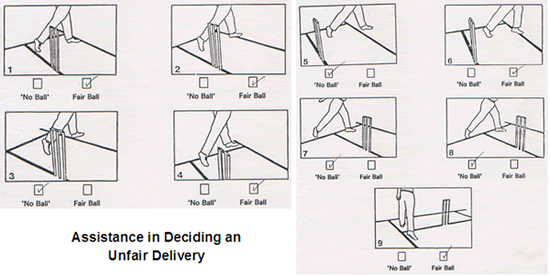
LAW 8.2 A game can only be abandoned due to ground/weather conditions. LAW 8.3 A team that refuses to continue with a game, for any other reason, shall be deemed to have conceded the game. If the first innings is completed then bonus points and man of the match for both sides will be awarded. The willing team will have 5 points awarded; the conceding team will have 5 points deducted and future conduct monitored. Where there is any controversy, including extreme cases where a team feels that they could not have continued the game, a written report can be accepted by the MC after the completion of that game, for the purposes of review and/or appeal. To be considered, any written report must be received no later than the Saturday following the scheduled week of the fixture; perhaps announcing further details to follow as soon as they have been collated. The MC's decision will be final. See also Law 7.5. LAW 9 Score CardsTeam captains shall agree the final score before leaving the ground. The score card shall be completed and signed by one representative from EACH team and forwarded to the Information Secretary by the WINNING team as soon as possible. Full names of the best performers are preferred. Clubs are encouraged to ALSO email results via the website to aid prompt reporting. LAW 9.1 A £5 fine will be imposed if scorecards are not submitted by the winning team WITHIN ONE WEEK following the playing of a League fixture or Cup game. If the scheduled or rearranged fixture is not played and an informative scorecard is not submitted WITHIN ONE WEEK (see Law 2) then a £5 fine will be imposed on the Home Club whose responsibility it is to inform the Information Secretary. This is to encourage all Clubs to keep the MC information, to keep the League Table up to date and to avoid late claims for alleged defaults. LAW 9.2 In the event of a fixture not able to be rearranged, a scorecard claiming one point per Club in lieu of the fixture, in accordance with Law 2, should be submitted to the Information Secretary by the Home Club immediately following the current period in which the game could have been played. Failure to submit a card will result in the awarding of one point per Club in lieu of the fixture and Law 9.1 will apply. LAW 10 League PositionsAll League divisional positions will be decided on a basis of points totals. If two Clubs have the same points total, the higher placed team will be decided on the basis of number of wins (including defaults). If this is the same then the higher number of batting points will decide, or else the total number of runs scored will decide. LAW 11 TrophiesThe Management Committee will arrange for provision of a cup for the winner of each Division of the League and for the Cup competition and a shield for each of the divisional runners up and the losing finalists in the Cup competition. An evening for presentations will be arranged. Law 11.1 The holders of the cups and shields from the previous season must return them to the League Secretary before or at the final (September) meeting of the League for the current season. Failure to return a trophy by this time will incur a fine of £5. LAW 12 Cup TiesCup ties, with the exception as specified below for the Cup Final, will be played in an evening, with the number of overs and conditions as specified in LAWS 5, 6 and 7 for League fixtures. In the case of LAW 7 being violated, the tie will be forfeited. LAW 12.1 Prior to a Cup Quarter‑ or Semi‑Final, the opposing teams will be responsible for arranging for two neutral umpires and for then informing the Information Secretary. The MC will assist in obtaining suitable umpires. LAW 12.2 As per Law 8, a result will be obtained in an uncompleted Cup tie (including the Cup Final) if half of the agreed number of overs is bowled in the second innings. If this many overs cannot be bowled then the Cup tie must be replayed. LAW 12.3 If a Cup tie is tied by a leveling of the scores, then the winning team will be the one, which has lost fewer wickets. If however this is not a deciding factor then the runs totals and possibly wickets after 10 overs will decide. In the case of the Cup Final the scores after half of the number of overs being played will be compared. In either case if the compared scores are the same for both sides then the scores after 2 less, 4 less, etc. overs will decide. It is therefore necessary to agree and record the score after each over. LAW 12.4 For Cup games the Secretary of the winning team will inform the Information Secretary of their victory as soon as practicable to enable matches of a subsequent round to be arranged expediently. Note that LAW 9 also applies. LAW 13 The Cup FinalThe Cup Final will be played on a Sunday with a prompt 1:30 p.m. start and shall be of 30 off 8 ball overs for each side unless the Captains agree a shorter match. The League will provide a new ball for the start of each innings; should these be damaged or lost then the fielding side will be expected to provide a suitable replacement ball. LAW 13.1 The maximum allowed to each bowler in a match of 26 or more overs shall be 6 overs; in a match of 21 to 25 overs the maximum shall be 5 overs; in a match of 20 or less overs the maximum shall be 4 overs. LAW 14 Fees and FinesAll fees and fines will be increased by £5 for each full calendar month that they are not paid. LAW 15 WebsiteThe website will be run by the WebMaster and input must comply with a set of agreed Terms and Conditions. Contentious or offending material will not be tolerated. The Management Committee will also monitor the site; any offending Club will have their input facility withdrawn. Clarification of the MCC Laws of Play as adopted by the League:Wide Ball, MCC Law 25: If the ball passes out of the reach of the batsman standing in a normal guard position whether through height or width the umpire should call and signal a wide ball; one run is scored. The reach of the individual batsman must be considered. If the batsman brings the ball within his play by moving and then misses the ball then this no longer constitutes a wide. On the other hand, the batsman cannot make a wide by moving away from the line of the ball. The range of strokes on the leg side determines that the width of delivery required to be a wide is less. As a general guideline, the League recommend that “a wide” is a ball which passes the line of the stumps, without any contact being made and without the ball passing over or under the bat, outside of either (on the off side) three feet from off stump or (on the leg side) one foot from the leg stump. No Ball, MCC Law 24: To avoid bowling a no ball the back of the front foot whether grounded or raised must be behind the popping crease, i.e. the back edge of the crease. The part of the back foot which touches the ground first must be within the return crease or its forward extension, i.e. the inside of the crease marking. See examples in the figure supplied. Bouncers, Law 42: If, in the umpire's opinion, a fast short pitched ball which passes or would have passed the batsman at above head height in his normal stance then: Beamers, Law 42: A full pitched ball, i.e. a ball which passes or would have passed above waist height of the batsman standing in a normal position, is a no ball. The procedure as for Bouncers applies. NEMWCL variation: the square leg umpire CAN call the no ball. LBW Fundamentals: The ball must not have touched the bat before it hit the pad and it must, in the opinion of the umpire, have been going to hit the wicket. The ball may have pitched anywhere except outside of leg stump. If the impact is outside of off stump then if the batsman tried to hit the ball he is not out, but he can be given out if no stroke is offered. Additional Guidance Notes:Players are reminded that the League constitution is intended to be that of a recreational league, i.e. 'friendly league', albeit a competitive league. Cricket is a game that owes much of its unique appeal to the fact that it is expected to be played not only within the laws, but also within the spirit of the game. The conduct of individuals and especially of their team captains, upon whom the major responsibility falls, should reflect this fundamental point. The participation in the League by players of a widely varied standard of ability and age is to be encouraged by considerate play. Clubs violating the spirit of this guidance should be reported to the Management Committee. Regarding particular fixtures where problems have arisen in the past, it is recommended that the Clubs involved should consider arranging for at least one neutral umpire. The League Officer, or Information Secretary in the case of a Cup fixture, would assist the Clubs to obtain suitable umpires and a suggestion list is included in the Fixtures Booklet. The associated expenses for the provision of the umpires must be met by the Clubs involved in the fixture. The umpires are sole judges of fair and unfair play and may intervene at any time, whereupon it is the responsibility of the team captains to take action where required. It is pointed out that the agreed number of overs to be bowled in a fixture should be realistic, with due consideration given to the anticipated time-span for suitable light conditions. It is important for matches to be completed in conditions which are reasonable for both batting and fielding. If agreed by the Clubs involved, the playing of fixtures at weekends or in advance of the scheduled week is permitted. The cricket balls to be used should be of a reasonable standard and condition and reasonably light in colour, especially on a relatively dull evening. Professional players are not eligible to play in either League or Cup. Regarding the playing of Guests, as defined in the Laws of the League, Clubs are reminded that the prior permission of the opposition and the League Officer (Information Secretary for Cup ties) is required. This Law is not intended to permit the sudden introduction of a player of significant quality at the expense of a regular Club squad player; rather it is to enable a full team to be fielded on occasions when the regular players are unavailable. It is the Home Club's responsibility to try to provide a suitable scoreboard which is clearly visible from the field of play. If a scoreboard is not available then the score at the end of each over should be relayed to the field and confirmed by the umpires. No retrospective changes are to be made. Sight screens, if available, must be outside of the boundary area, or a rope must be placed in front if this is not practicable. Furthermore, in the interests of health and safety, Home Clubs are expected to be able to provide suitable basic ground and first aid facilities, including, at least, running cold water. Please ensure that scorecards are filled in correctly and sent to the Information Secretary as soon as possible by the WINNING team (or by the Home Club for an abandoned fixture). If a game is not played within the permitted weeks, then a card must be sent promptly and within one further week, by the Home Club. Innings details for the winning team must be given on the left side of the card (batting and bowling together) and innings details for the losing team must be given on the right side of the card. To facilitate improved information, especially in the press the use of full names on the scorecards is encouraged. Junior Players, i.e. aged under 17 in the September prior to the current season, must be suitably protected by the wearing of an approved standard helmet whenever batting or fielding close to the wicket. Except for representative fixtures, the League shall not be liable for the protection of junior players; individual Clubs are held responsible for the safety of their junior players. Juniors who do not have, or can not be provided with, the necessary protection must not partake in any League or Cup fixture. Furthermore, a fielder who is aged under 13 must not field within 11 yards from the middle stump. Except behind the wicket on the off side. Similarly, an under 15 must not be within 8 yards. The Safe Hands Initiative can be downloaded from the welfare section of the ECB website www.play-cricket.com. This gives guidance for the safe welfare of junior players and vulnerable adults. It is the responsibility of individual Clubs to make their members and associates aware of the dangers and to adhere to the guidelines. Impact of MCC Law Changes (2001):
Wicket Keeper's Gloves: Observance of the minimum webbing rule preferred, not mandatory. NB! MCC Law 24 Point 5: For a delivery to be fair in respect of the feet, in the delivery stride: (i) the bowler's back foot must land within and not touching the return crease. Recording wides and no balls correctly in the scorebook:
|
|
|||||||||||||||||||||||||||||||||||||||||||||||||||||||||||||